Blog
How to Load and Transport a Mini Excavator Safely

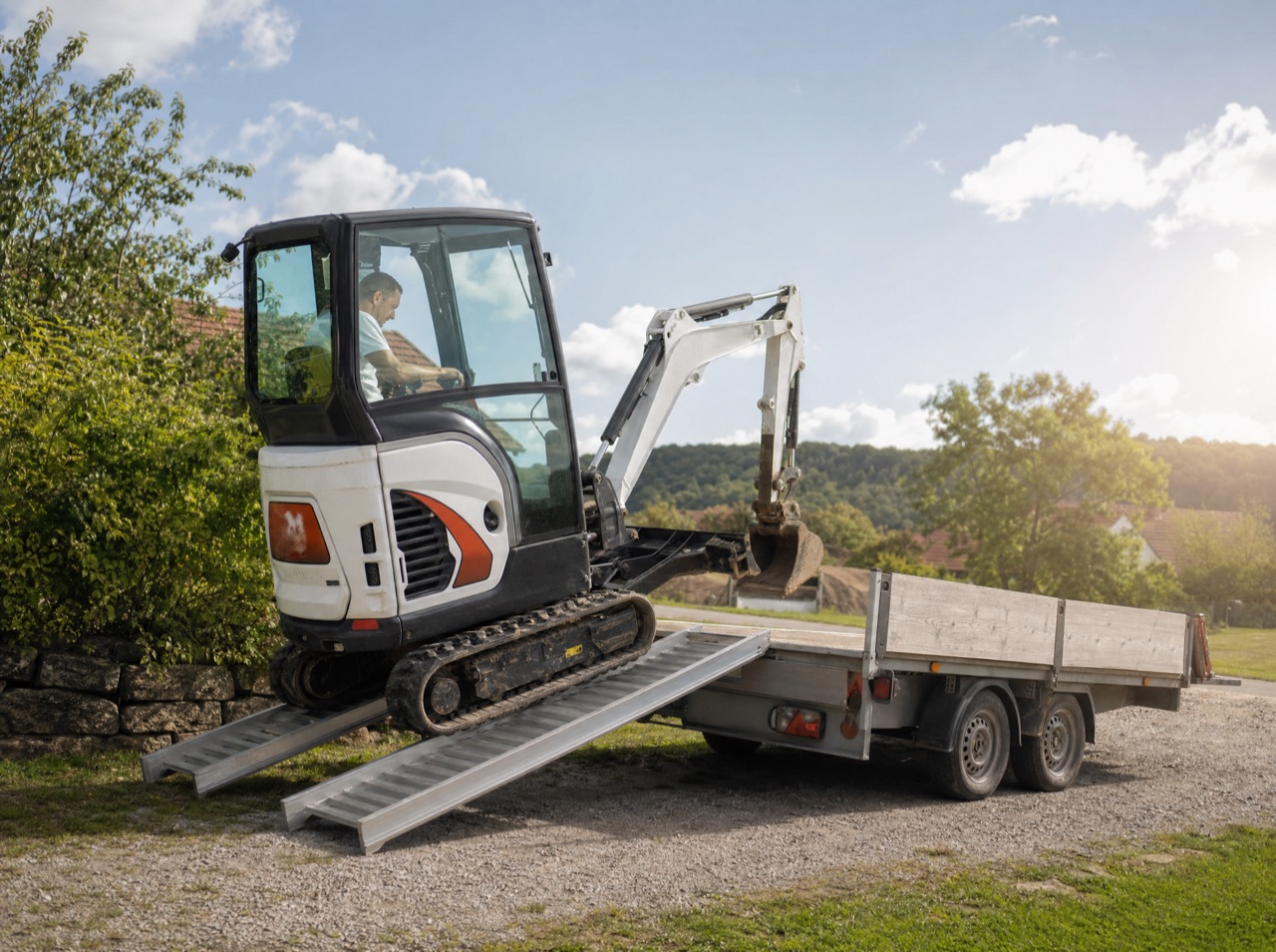
Moving a machine is where a lot of avoidable damage and danger happens. Knowing how to load and transport a mini excavator safely protects your equipment, your truck, and everyone sharing the road with you. Whether you are a landscaper hauling a 1.5-ton unit between job sites or a rancher moving a 6-ton machine across the property, the fundamentals are the same: match the equipment to the load, control the slope, and secure everything to spec before you pull away.
Know your weights before you touch the trailer
Every safe move starts with numbers. A mini excavator’s operating weight is only part of the picture. Add the weight of any attachment, a full fuel tank, and the trailer itself, then compare that total against three limits.
- Trailer GVWR (gross vehicle weight rating): the most the loaded trailer is rated to carry, including its own weight.
- Tow vehicle towing capacity: found in your truck’s manual or door-jamb sticker, not on a marketing brochure.
- Hitch and tongue rating: the receiver, ball, and coupler all have their own limits, and the weakest one governs.
If your machine plus attachments approaches a trailer’s ceiling, step up to a heavier-duty trailer rather than running at the edge. Compact excavators range widely in weight, so confirm the figure on the spec sheet for your exact model. You can review operating weights for every machine on our mini excavators page before you commit to a trailer.
Choosing the right trailer and ramps
For most mini excavators, a deck-over or equipment trailer with a beavertail and fold-down ramps works well. The two details that matter most are deck width and ramp design.
Deck and ramp width
Your trailer deck and ramps must be wider than the machine’s track width, with room to spare. Tracks that hang off the edge of a ramp are a leading cause of tip-overs during loading. Solid-surface or close-spaced ramps grip rubber and steel tracks better than widely spaced bar ramps.
Ramp angle
The steeper the ramp, the greater the risk that the machine high-centers, slides, or pitches as it crests the top. Longer ramps create a gentler angle and a smoother transition onto the deck. A flatter approach is always safer, especially with rubber tracks that can lose grip on a steep, wet, or muddy ramp.
How to load a mini excavator: step by step
This is the core of learning how to load and transport a mini excavator safely. Work slowly, keep bystanders clear, and never rush the ramp.
- Park and chock. Position the trailer on firm, level ground. Set the tow vehicle’s parking brake and chock the trailer wheels so nothing rolls.
- Inspect ramps and deck. Confirm ramps are fully seated, pinned, and free of mud, ice, or oil. Clear the deck of debris.
- Orient the machine correctly. Most operators load with the boom and bucket facing uphill (toward the front of the trailer) so the heaviest end leads and the counterweight follows. Follow your operator’s manual if it specifies otherwise.
- Approach straight and centered. Line up squarely with the ramps. Keep both tracks evenly on the ramp surface and avoid steering corrections mid-climb.
- Travel slowly at low engine speed. Use a steady, slow track speed. Sudden movements on an incline are what cause slides and tips.
- Crest carefully. As the machine transitions from ramp to deck, the body will pitch forward. Expect it, ease the controls, and keep the bucket low.
- Set down and center the load. Position the machine so its weight sits over the trailer axles, then lower the bucket or blade to the deck and rest it there.
- Shut down properly. Engage the travel lock and any swing lock, lower all attachments fully, idle down, turn the engine off, and remove the key.
Securing the machine: tie-downs that actually hold
A common rule of thumb for transporting heavy equipment is a minimum of four independent tie-down points, with chains or straps rated to handle the machine’s weight. Many operators follow the four-corner method.
- Use the manufacturer’s tie-down points. Most mini excavators have designated lugs or holes on the undercarriage and frame. Anchor to those, not to hydraulic lines, cylinders, or the cab.
- Pull at opposing angles. Run chains forward from the front of the machine and rearward from the back so the machine cannot shift in any direction.
- Match the hardware. Chains, binders, and the trailer’s D-rings must each be rated for the load. The weakest link sets your real capacity.
- Tension the implements separately. If the boom, bucket, or blade can move, secure or lower them so road vibration cannot work them loose.
Many regions require the equipment to be secured against forward, rearward, and side movement, so do not rely on the machine’s weight alone to hold it in place. A loose machine on a highway is a worst-case scenario for everyone.
Your pre-departure transport checklist
Run this quick checklist every time, before the trailer leaves the yard.
- Machine centered over the axles and resting on its blade or bucket.
- Engine off, key removed, travel and swing locks engaged.
- At least four rated tie-downs pulling in opposing directions.
- Binders tightened and secured so they cannot vibrate open.
- Ramps stowed, pinned, and latched.
- Trailer lights, brakes, and turn signals tested and working.
- Tire pressures and lug nuts checked on truck and trailer.
- Coupler latched, safety chains crossed under the tongue, and breakaway cable connected.
- Load within trailer GVWR, towing capacity, and hitch ratings.
- Wide or heavy loads flagged and permitted where required by your state.
Recheck your tie-downs after the first few miles. Chains and straps settle as the machine seats itself, and a quick re-tension at a safe pull-off prevents a slow load from going slack on the highway.
Unloading and over-the-road habits
Unloading reverses the process, but it deserves the same patience. Park on level ground, chock the wheels, remove tie-downs only after the machine is ready to move, and back down the ramps slowly with the heavy end uphill. On the road, allow longer stopping distances, take corners gently, and stay aware of your trailer’s added length and sway. Smooth inputs keep a high, narrow machine planted on the deck.
What is the safest way to position a mini excavator on a trailer?
Center the machine over the trailer’s axles so weight is balanced front to rear, with roughly 10 to 15 percent of the load on the tongue for stability. Lower the bucket or blade onto the deck, engage the locks, and shut the engine down before securing.
How many tie-downs do I need to transport a mini excavator?
Use at least four independent, rated tie-downs as a baseline, anchored to the manufacturer’s tie-down points and pulling in opposing directions. Heavier machines and longer hauls call for additional chains. Always confirm your hardware is rated for the machine’s full weight.
Do I need a special trailer for a mini excavator?
You need a trailer whose GVWR, deck width, and ramp capacity exceed your loaded machine, not a brand-specific one. Match the trailer to the heaviest unit you plan to haul, and verify your tow vehicle and hitch can handle the combined weight.
The bottom line
Learning how to load and transport a mini excavator safely comes down to discipline: confirm the weights, control the ramp angle, center the load, and secure it with rated tie-downs pulling in opposing directions. Get those steps right every time and you protect your investment, your crew, and the road. When you are ready to add a machine you can move with confidence, browse our full lineup on the shop page, compare options across our compact excavator range, and reach out through our contact page if you want help choosing the right unit and trailering setup.